Costa Rica beach safety is mostly about knowing what to watch for. The water here is warm and gorgeous, but a lot of the most beautiful beaches have strong currents, only a handful have lifeguards, and there are a few other things to know about, like crocodiles near river mouths and a sun that burns you in no time.
Thomas and I have lived in Costa Rica since 2016 and spend a lot of our time at the beach. We’ve seen how fast calm-looking water can turn dangerous, and we’ve also learned a few things the hard way (sunburns and a stingray included).
Below, we cover how to spot a dangerous current and get out of one, how to pick a safe place to swim, beaches that are good for kids, snorkeling and sun safety, and the wildlife to watch out for.
Quick answer
Costa Rica’s beaches are safe to enjoy as long as you know what to watch for. Strong currents are the biggest danger, so swim near other people, look for red or yellow flags and pick calmer bays like Sámara, Playa Hermosa in Guanacaste or the beaches inside Manuel Antonio National Park. If a current pulls you out, stay calm, float and swim parallel to the shore. Also avoid river mouths (crocodiles) and wear a sun shirt in the water.
Rip Currents Are the Biggest Danger at Costa Rica’s Beaches
A rip current is a narrow channel of water rushing away from the shore. It won’t pull you under, but it can carry even strong swimmers out past the waves really fast. People get into trouble when they panic and wear themselves out trying to swim straight back in.
A lot of people call them riptides. They cause most of the drownings at the beaches here every year, and they show up on calm-looking days too, especially on surf beaches and around low tide.

You’ll see signs like this one at Playa Esterillos at a lot of beaches. It’s in Spanish, so here’s what it says:
If you get caught in a rip current (corriente de resaca), swim parallel to the shore and don’t try to swim against it. If you’re a strong swimmer, you can let it carry you out to where it ends, past the breaking waves, then swim back in at an angle. If you can’t do either, float, kick and shout or wave your arms for help.
It also says to ask locals or lifeguards which spots are safest, stay out of the ocean if you can’t swim or have been drinking, check the water from somewhere high like a hill or building, and keep an eye on kids even when they’re just playing at the water’s edge.
How to Spot a Rip Current
- A gap in the breaking waves where the water looks calmer and flatter
- Darker, deeper-looking water
- Foam, seaweed or sandy, murky water moving out to sea
- Choppy, rippled water in a line heading away from the beach
What to Do If You Get Caught in One
- Stay calm and float. You won’t get pulled under, so save your energy.
- Don’t swim straight back to shore. You’ll be swimming against the current and get exhausted fast.
- Swim parallel to the beach until you feel the pull stop, then angle back in with the waves.
- Signal for help if you can’t get out. Float, wave your arms and shout.
If you see someone else in trouble, call for help and throw them something that floats, like a boogie board or cooler. Don’t swim out after them unless you’re trained, since a lot of drownings here are people trying to help.
How to Pick a Safe Place to Swim
Most beaches in Costa Rica don’t have lifeguards. A handful of popular ones do, like Manuel Antonio, Tamarindo and Playa Cocles, but even then the towers aren’t always staffed. I feel like it’s best to just plan on being your own lifeguard.
- Watch where other people are swimming. If everyone is swimming in one spot and nobody is in another, there’s usually a reason. Don’t be the only one out there.
- Ask locals. Surf instructors, beach bar staff and your hotel know which spots have currents.
- Check for flags and signs. A red flag means don’t swim, and yellow means be careful. No flag doesn’t mean it’s safe. A Blue Flag (Bandera Azul) beach is about cleanliness, not swimming conditions, so it can still have strong currents.
- Watch the water first. Spend a few minutes looking for the warning signs above before you go in.
- Don’t go deeper than your waist if you’re not sure about the conditions.
- Never swim alone or after drinking, and stay out of the water at night.
Safest Beaches in Costa Rica for Swimming

Protected bays and beaches with a reef offshore are usually the calmest. Surf beaches are great for surfing and walks, but in our experience they’re not the best for a relaxing swim. I think Sámara is one of the easiest beaches in the country for a relaxing swim.
| Usually calmer (still check) | Often strong currents or big surf |
|---|---|
| Playa Hermosa (Guanacaste) | Jacó, especially at low tide |
| Sámara and Playa Carrillo | Playa Hermosa near Jacó |
| Playa Flamingo and Playa Conchal | Esterillos |
| Playa Ocotal and Playa Potrero | Playa Guiones (Nosara) |
| Manuel Antonio beaches inside the park | Dominical |
| Playa Biesanz (Manuel Antonio) | Santa Teresa |
| Punta Uva (Caribbean) | Playa Cocles on rough days |
Conditions change every day with the swell, tides and weather, so even calm beaches can have currents. Our guides to the best beaches in Costa Rica, Manuel Antonio beaches and Jacó beaches describe each one.
Best Beaches for Kids
If you’re traveling with little ones, stick to the calm bays. Playa Hermosa in Guanacaste is one of our favorites for families because it has a blocked-off swimming area, so boats and jet skis stay out of the way.
Sámara, Playa Carrillo and the beaches inside Manuel Antonio National Park are also usually calm enough for kids.
Keep an eye on kids even when they’re just playing at the water’s edge, since waves can knock them over fast. See our Costa Rica with kids guide for more family tips.
Snorkeling and Boat Tour Safety

- Don’t go too far from the boat. Currents can be strong even when the water looks calm, and it’s easy to drift without noticing.
- Stay with your guide and a buddy. Keep an eye on each other the whole time.
- Wear a life vest or grab a flotation noodle. Most tours have them (and require you wear them).
- Tell your guide if you’re nervous in the water. They’d much rather know upfront.
- Don’t touch the coral or the animals, and watch for sea urchins on rocks.
If You’re Not a Confident Swimmer
That’s totally fine, and you can still enjoy the beach here. Stick to calm bays, stay in water where you can touch the bottom and wear a life vest on any boat or snorkel tour. A pool or a calm beach like Sámara is a much better choice than a surf beach.
Planning your beach days? These are worth sorting out before you go.
Book these early
Sun Protection at the Beach (Wear a Sun Shirt!)
OMG, the sun in Costa Rica is so strong, even on cloudy days. You’re close to the equator, and between the water and the sand reflecting it, you burn a lot faster than you think.
Sarah’s Tip
Wear a long-sleeve UV shirt in the water. You might feel a little silly, but trust us. We’ve been on so many day tours, especially snorkeling tours, where everyone else is in their bathing suits and Thomas and I are in our long-sleeve UV shirts. By the end of the day, everyone else is a tomato except for us.
- Use a reef-safe sunscreen and reapply after swimming
- Wear a hat and sunglasses on the beach
- Find shade between about 10 am and 2 pm, when the sun is strongest
- Drink lots of water
One thing I love is that the water here is always warm. The sand is another story. By midday, especially on darker sand, it can get way too hot to walk on, so wear sandals and watch out with kiddos, since little feet burn fast.
Read more in our guide to the sun in Costa Rica.
Crocodiles and Other Wildlife to Watch Out For
Crocodiles
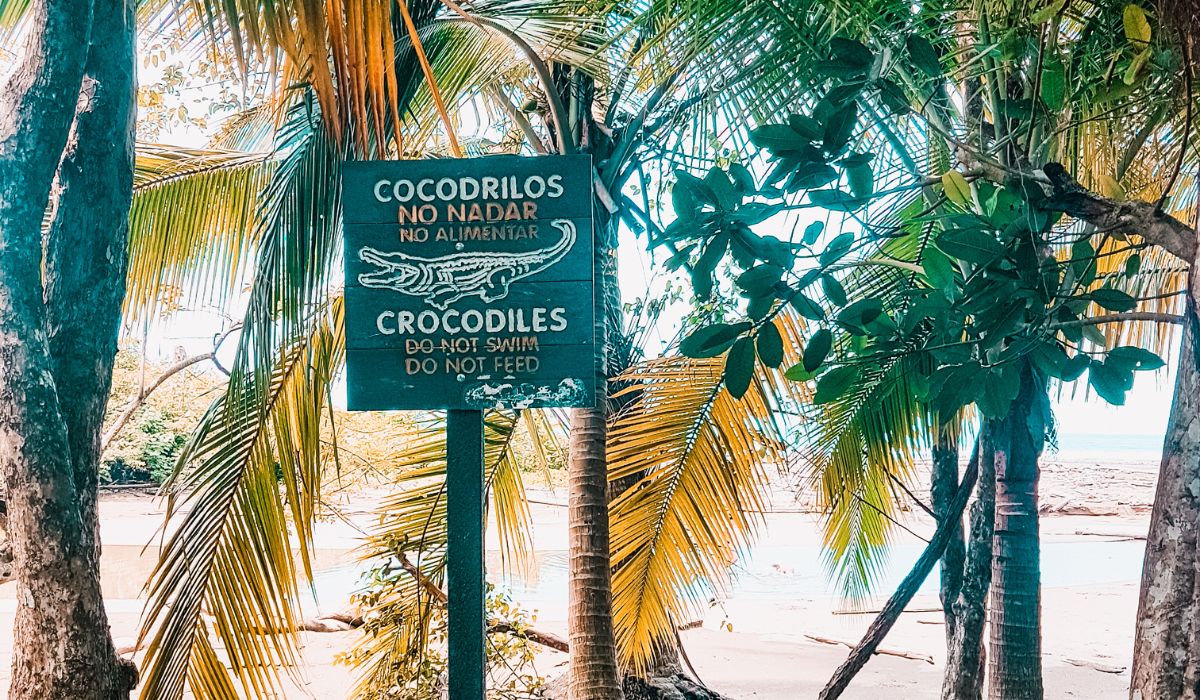
Crocodiles live in rivers and estuaries all over Costa Rica, and they sometimes swim out to the beach. Don’t swim near river mouths or estuaries, especially at dawn, dusk or after heavy rain. If you see a crocodile sign like this one, take it seriously and swim somewhere else.
Sarah’s Tip
OMG, I’m so freaked out by crocodiles. I stay far, far away from any water that’s even slightly near a river mouth. I feel like it’s just not worth it, no matter how nice the water looks.
Stingrays
Stingrays like to hang out in shallow, sandy water, especially on calm beaches. Shuffle your feet when you walk in so they swim away instead of getting stepped on.
Sarah’s Tip
Thomas got stung by a stingray on his foot one time at Playa Hermosa. He wouldn’t let me pee on it (just kidding….that is apparently a myth anyway). What actually helps is soaking it in water that’s as hot as you can stand, and getting it checked if the pain doesn’t ease.
Jellyfish and Sea Urchins
Jellyfish show up at some beaches during certain times of year, and sea urchins hide on rocks and reefs, so wear water shoes around rocky spots. Our dangerous animals guide covers the rest.
River Safety: Watch Out for Flash Floods
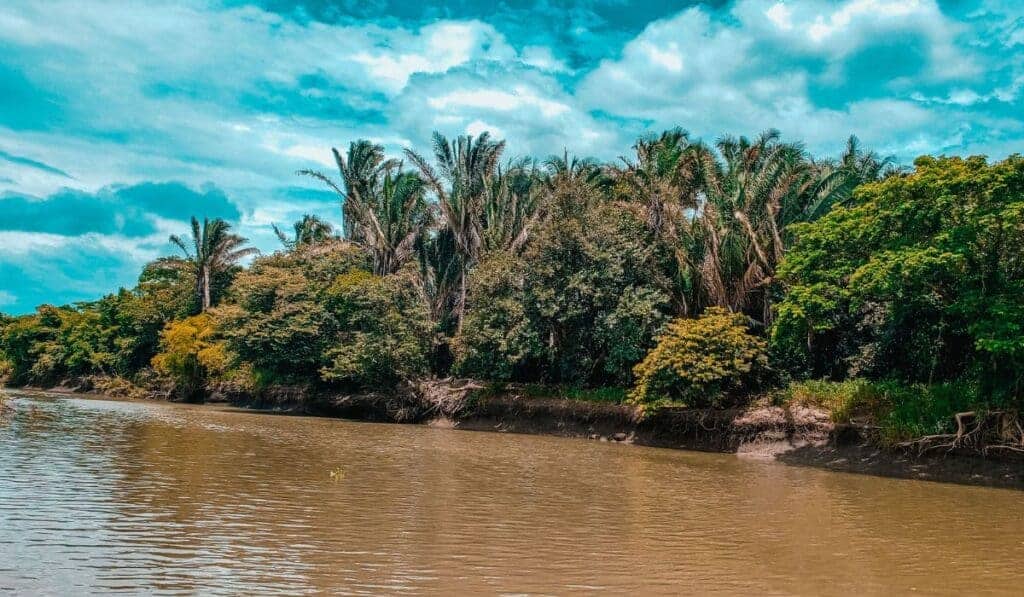
This one isn’t a beach tip, but I think it’s just as important. Flash floods (cabezas de agua) do happen in Costa Rica’s rivers, especially in rainy season, and a river can rise really fast even when it’s sunny where you are, because the rain is falling upstream in the mountains.
Get out of the water right away if you notice any of these:
- The water suddenly turns brown or muddy.
- Branches and leaves start floating by.
- The water level rises or the current gets stronger.
- You hear rumbling upstream.
- There are dark clouds over the mountains.
If you see any of these signs, head to high ground right away. Never try to cross a swollen river, and always follow guides and closures at waterfalls and swimming holes.
More Beach Safety Tips
- Don’t leave your things alone. Bags left on the beach while you swim are an easy target, so only bring what you need.
- Save the emergency number. Call 911 for any emergency in Costa Rica.
- Get travel insurance. Here’s why we recommend it.
- Be careful in the surf. If you want to learn, take a lesson with a local instructor. See our surfing guide.
Costa Rica Beach Safety FAQ
Are Costa Rica beaches safe to swim?
Many are, but rip currents are common, especially on surf beaches. Swim near other people, watch for flags and stick to calmer bays if you’re not a strong swimmer.
What do you do if you get caught in a rip current?
Stay calm and float, don’t swim straight back to shore, and swim parallel to the beach until you’re out of the current. Then angle back in, or float and wave for help.
Do Costa Rica beaches have lifeguards?
Only a handful of popular beaches do, like Manuel Antonio, Tamarindo and Playa Cocles, and the towers aren’t always staffed. Plan on being your own lifeguard.
What are the safest beaches for kids in Costa Rica?
Calm bays like Playa Hermosa in Guanacaste, Sámara, Playa Carrillo and the beaches inside Manuel Antonio National Park.
Are there crocodiles at Costa Rica beaches?
Sometimes, near river mouths and estuaries. Don’t swim near them, especially at dawn, dusk or after rain, and always follow crocodile warning signs.
Are there sharks at Costa Rica beaches?
Shark bites are extremely rare here. Rip currents are a much bigger risk.
Staying in a beach town? For more than beach safety, read our Tamarindo safety and Jacó safety guides, and our full guide to whether Costa Rica is safe.
Plan Your Costa Rica Trip Like a Pro
🏨 Browse our hand-picked hotels: Search stays we actually recommend, with smart filters, clear locations, and plenty of free-cancellation options.
🏡 Find vacation rentals that make sense for your trip: From jungle villas with pools to laid-back beachfront homes.
🚗 Save 10% on your car rental: Plus free second driver, 0% deductible, and great service (this is who we use ourselves).
🚐 Compare shuttles & private transfers: Easy airport pickups and point-to-point rides anywhere in Costa Rica. Use code: SARAHMC5 at checkout.
✈️ Compare flights: We use Skyscanner to compare routes, prices, and flexible dates, especially helpful when flying into or out of Costa Rica’s different airports.
🛡️ Travel insurance: We always recommend traveling Costa Rica with insurance that covers medical care, trip interruptions, and adventure activities. It’s one of those things you hope you don’t need, but are very glad to have if plans change.
Travel easier
Plan Smarter, Travel Easier
Before you go, here are the tools we use for every Costa Rica trip.
Need help planning? Try our free day-by-day trip planner, grab our 7-day itinerary for first-timers, or join our email list and we will walk you through it step by step.

Meet the writer
Sarah McArthur
Sarah is the co-founder and main writer of Costa Rica Vibes. Originally from the US, she has lived in San José, Costa Rica since 2016 with her husband Thomas, who takes the photos you see on this site.
Together they have been writing about Costa Rica since 2017, drawing on years of road trips, hotel stays and tours around the country. We personally vet everything before we publish it.
Follow along on Instagram · Pinterest · Substack
or join our email list for trip planning help.