When driving you will need to fill up on gas in Costa Rica. There are gas stations all over the country, but there are a few things you need to know before pulling up to the pump.
We have years of firsthand experience on Costa Rica’s roads. So, we created this guide to give you info on the current gas prices, how to find a gas station, basic gas station Spanish, and more helpful tips.
Getting Gas in Costa Rica at a Glance
- Prices: One supplier (RECOPE) and government-regulated prices, so gas costs the same everywhere. Expect about $4.50 to $5.50 a gallon ($1 to $2 per liter).
- Colones and liters: Prices are listed in colones and measured in liters. The free XE Currency app helps with the math.
- Full service: An attendant fills the tank, so stay in your car. Say “Lleno con regular, por favor.”
- Which gas: Regular (91 octane, red sign) is what most rental cars take. Super is 95 octane (blue sign), and diesel is usually green.
- Check the pump: Make sure the meter starts at zero, and that your receipt and card amount match the pump total.
- Real story: My dad’s 20,000 colones ($38) purchase almost got entered as 200,000 ($382). Seriously, double-check.
- Payment: Cash in colones and major credit cards work. Ask first at remote stations, since most places won’t take debit cards.
- Tipping: Not needed, but we give about 500 colones if they wash the windshield.
- Finding gas: Stations are mostly on main roads, not downtown. Rental cars usually start with a full tank, so return them full.
- Airport fill-ups: At SJO, try Estacion de Servicio Pacific. At Liberia, Estacion de Gasolina Full is right across from the airport.

Gasoline Prices in Costa Rica
All gas stations in Costa Rica get their gasoline from one supplier called RECOPE (Refinadora Costarricense de Petróle).
The fuel prices are then regulated by the government.
This means that no matter where you go in Costa Rica, the gas prices will be exactly the same. No need to drive around searching for the best price!
Keep in mind that prices will be listed Costa Rican colones which is the local currency.
Also, measurement is in liters not gallons.
So, you will need to be up on the current exchange rate to calculate the price in US dollars or another currency. The best way we have found to do that is the free app XE Currency Exchange.
If you are from the United States, you will also need to convert liters to gallons to better grasp the cost.
The average price of gasoline in Costa Rica is typically between $4.50 and $5.50 a gallon in United States dollars. Or around $1 to $2 per liter.
You can check out the exact current Costa Rican gas rate here.
Finding a Gas Station
Most gas stations in Costa Rica are located on main roads. There aren’t a lot of gas stations in the downtown areas of each town.
In very remote locations there are sometimes only local people who act as the local gas station. We experienced this with a friend after having only lived in Costa Rica for about two months. She drove us down this dirt road to some random guy’s house and he brought gas tanks out to fill our car. We then paid and left.
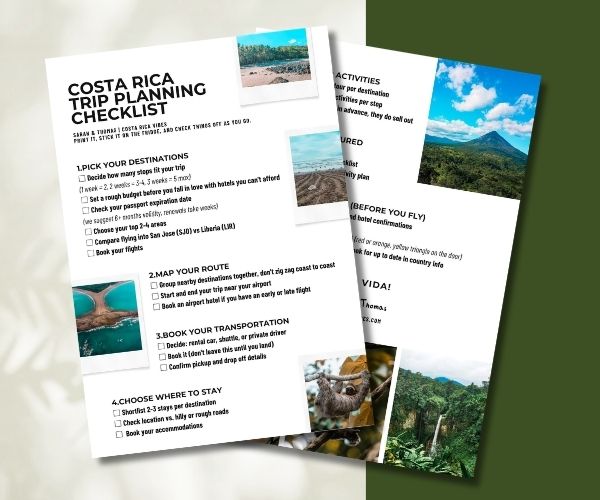
Planning a trip to Costa Rica? We’ll walk you through it step by step
Sign up now & get your free trip planning checklist instantly.
Thomas and I were both like “What is happening right now?!”
But, that is the only time we have ever experienced that and it was with local friends. Typically, you will be able to find a regular normal gas station.
If you are using Waze or Google Maps for driving directions there is a button to press to find a gas station along the route. Sometimes I find they don’t work very well and it will try to take you to a gas station off of your intended travel plan. So, you will have to mess around with it a bit.
In all of our destination guides, we included info on where the nearest gas station is in the Background Info section.
Gas Stations Near the International Airports
From the San Jose International Airport, there are a few nearby gas stations. If you are returning a rental car, the easiest gas station to stop at is likely Estación de Servicio Pacific.
From the Liberia International Airport, there is now a large gas station directly across from the Airport. It is called Estación De Gasolina Full. There is also a small mini market if you would like to get a drink or snack before your flight.
If you are coming from the south and returning your car at Adobe Rent a Car, we suggest swinging in Delta El Coco to get fill your car before returning it. This gas station is located just before the turn to the Adobe office.
Note: I am pretty sure that all rental car companies in Costa Rica give you the car with a full tank of gas. You will then be responsible for returning the car with a full tank as well.
Types of Petrol in Costa Rica


In Costa Rica you will often see three types of gasoline. These are Regular, Super, and Diesel.
Regular: This is most likely what you will want to fill your rental car with. It is regular gasoline with 91 octanes. Sometime in Costa Rica, the sign will refer to it as “plus 91.” Typically the sign for this fuel type will be colored red in Costa Rica. This is the cheaper of the two normal gas variants.
Super: Super is the premium gasoline version. It contains 95 octanes. In Costa Rica, the sign for super gasoline is typically blue.
Diesel: A lot of people in Costa Rica drive diesel vehicles. But, if you are renting a car it is most likely not a vehicle that takes diesel. Diesel is usually green on the signs at Costa Rican gas stations.
How to Have Your Gas Tank Filled

All gas stations in Costa Rica are full-service. This means that you will stay in your vehicle and the gas station attendants will fill your car up with petrol for you.
So, knowing a little bit of Spanish can be helpful for these interactions.
When you pull up to the pump you can say, “Lleno con regular, por favor.” This means, “Fill it with regular (gas) please.” you can substitute the word “regular” for whichever gas type you need.
The gas station attendant will fill your tank and return with the total cost once they are done.
Sometimes while the gas tank is being filled the attendant will wash your windshield. If they wash the windshield we usually give them about 500 colones as a tip and thank you. Otherwise, you really do not need to tip them.
Also, note that the gas pumps typically have a very long hose. The employee might ask you to just pull forward and you might be thinking “but the gas tank is on the other side of my car!” Don’t worry. The hose is most likely long enough and they will just walk around your car with it.
💡 Sarah’s Tip
Make sure the attendant resets the meter to zero before pumping. Then check that the amount on the pump matches your card receipt, and keep the receipt.
Paying for Your Gas
Typically cash and major credit cards are accepted as payment. However, it is not a bad idea to ask if they accept cards before you fill up. This especially applies at really remote gas stations.
Most places will not likely accept debit cards. Additionally, I don’t suggest paying at all with a debit card in Costa Rica. A credit card is much better because if there is a fraudulent charge it is easier to fight it with your credit card company.
The gas stations also always accept cash in colones. They may also accept US dollars, but it is best to ask first.
When you pay for your gas, please double-check that the total on the gas pump and the amount that they say you owe are the same. Additionally, make sure that the credit card amount matches the amount on the pump.
We had an incident one time in which my dad bought gas here for 20,000 colones (about $38USD) but the attendant accidentally entered an extra zero on the credit card machine.
So, the total was 200,000 ($382).
Luckily the employee realized it right away and was so embarrassed. He quickly fixed the error and was able to avoid the transaction.
But, if the employee hadn’t noticed I’m not sure if my dad would have noticed. He is not familiar with switching between Costa Rican colones and US dollars. If it had said $380, he definitely would have noticed, but in colones, I’m not so sure.
So, lesson learned. Pay attention because mistakes happen.
Additional Services at the Gas Station

The gas station attendant can provide a few additional services if you need them. These are typically washing the windows/ windshield and checking the tire pressure.
To ask for this, you can say:
¿Podría por favor verificar la presión de aire en las llantas? – Could you please check the air pressure?
¿Podría limpiar el parabrisas? – Could you clean the windshield?
Again, it is polite to give the employee a small tip in coins as a thank you for these services if you request them. Typically we would give 500 to 1,000 colones.
Gas Station Facilities

The facilities at the gas stations in Costa Rica vary by location. Here are some of the things you might come across.
Restrooms
Most gas stations will have restrooms available. These are 90% of the time accessed from an exterior door. Meaning, you don’t need to actually go into the gas station to access them.
However, sometimes they are locked.
In this case, you will need to go to the gas station attendant and ask for the key.
Just say “¿Me podría dar las llaves del baño, por favor?” This translates to “Could you give me the keys to the bathroom please?”
Convenience Store
If you need some snacks and drinks for your Costa Rica road trip, the gas station convenience stores are always a good option.
Typically these stores carry candy, chips, crackers, granola bars, sodas, juices, and plenty of water. They are often a bit higher priced than the regular grocery stores.
Sometimes in Costa Rica, only cash is accepted for purchases under about $5. You can always ask though.
ATM
Some gas stations have an ATM inside. I would check which bank the ATM is affiliated with before using it.
In my experience, they often do not give the best exchange rate and may charge you a large transaction fee.
Usually, you are better off using an ATM attached to one of the main banks in Costa Rica (BCR, BAC, Scotiabank).
Pro Tip: If an ATM asks “Do you accept this exchange rate” I always select “no.” This typically does not cancel the transaction. Instead, it will say that it is up to your bank to provide the exchange rate. In my experience, my bank always provides a better exchange rate than the one the ATM offers.
Restaurant
Some gas stations may have a small restaurant attached to them. Typically these are places to grab a quick bite while driving.
However, this isn’t overly common in Costa Rica.
Usually, you will need to find another place to eat if you want a full meal.
Car Wash
If you have made your rental car very dirty while traveling, it is a good idea to have it cleaned before returning it.
If it is excessively filthy a lot of car rental companies will charge you additional cleaning fees and this can be expensive.
Typically it is way cheaper to have it cleaned yourself.
In Costa Rica, most car washes are not the drive-through type. Instead, you will pull in an area and an employee will wash down your car.
If you need to find a car wash look for the words “Lava Car.” This is a car wash.
Car Maintenance
Some gas stations also have a small garage for car maintenance. If you are traveling with a rental car, do not have any maintenance done without contacting the rental car company first. Typically they will want to handle any maintenance within their company.
Other Things to Note

- Make sure to check that the amount on your meter is the same as the credit card receipt amount. The amount is typically manually entered by the gas station attendant and mistakes can happen.
- Make sure the gas station attendant resets the meter to zero before starting to pump your gas.
- To enter the gas station follow the sign for “Entrada” and to exit follow the sign for “Salida”
- If you are alone, stay in the car while it is being filled. You can always pull off in a parking spot and lock your car to use the bathroom or go into the mini-market after.
- Make sure to get a receipt and keep it. That way you can cross-check at a later point if you see a higher charge on your card.
- If you are unsure if you should rent a car and drive in Costa Rica, check out our guide to car rental. This will give you more clarity to decide if it is the best option for you.
- If you would like to get the best deal in Costa Rica rental cars with a 10% discount plus other perks, head here.
Conclusion: Gasolene in Costa Rica
Now you know everything you need to know about petrol prices in Costa Rica. By using these tips you can have the best experience driving throughout the country and enjoying your experience in paradise.
If you have any questions about getting gas in Costa Rica don’t hesitate to leave them in the comment section below. We are always happy to help you out!
Don’t forget to check out our:
FAQ: Renting a Car and Driving in Costa Rica – Find out everything you need to know to be prepared to get on the road.
Driving in Costa Rica – A complete guide to road conditions, signs, and more!
Car Rental Scams in Costa Rica – What to watch out for and our experience being scammed
Costa Rica Transportation Guide – How to get around the country with ease
You might also be interested in:
- Driving in Costa Rica: What You Need to Know Before
- The Costa Rica Car Rental Scam: Why Prices Look Cheap (and What to Do Instead)
- Adobe Rent a Car Costa Rica Review: Our Honest Experience
- Costa Rica Car Rental: Key Tips for the Best Experience
- San Jose Costa Rica Airport (SJO) Arrival and Departure Guide
Travel easier
Plan Smarter, Travel Easier
Before you go, here are the tools we use for every Costa Rica trip.
Need help planning? Try our free day-by-day trip planner, grab our 7-day itinerary for first-timers, or join our email list and we will walk you through it step by step. Already have a plan? Send it to me for a personal review.

Meet the writer
Sarah McArthur
Sarah is the co-founder and main writer of Costa Rica Vibes. Originally from the US, she has lived in San José, Costa Rica since 2016 with her husband Thomas, who takes the photos you see on this site.
Together they have been writing about Costa Rica since 2017, drawing on years of road trips, hotel stays and tours around the country. We personally vet everything before we publish it.
Follow along on Instagram · Pinterest · Substack
or join our email list for trip planning help.