Crossing the Costa Rica Nicaragua border at Peñas Blancas is one of those things that sounds more intimidating than it actually is. I mean, in general, I think land border crossings can be intimidating.
Luckkily, after living in Costa Rica since 2016 and crossing this border ourselves, we can tell you that with the right prep it’s totally doable.
In this guide we’re covering everything you need to know from how to get to the border, exactly what happens on both sides, current fees, transport options, and an honest take on safety in Nicaragua so you can make an informed decision before you go.
Don’t Want to Read It All?
Short on time? Here’s the quick version of crossing into Nicaragua at Peñas Blancas.
- Check the current immigration rules before you go, since they can change.
- Bring your passport with at least 6 months of validity and cash in US dollars.
- Exit Costa Rica, walk down the road and enter Nicaragua.
- Just want a taste? A day tour to Nicaragua takes care of the logistics.
- Review the Costa Rica entry requirements for your return.
A Note About Safety in Nicaragua
Before we get into the logistics, we want to be upfront about the whole safety thing.
As of 2026, the U.S. State Department has Nicaragua at a Level 3: Reconsider Travel advisory.
The main concerns are not street crime, they are the Nicaraguan government’s arbitrary enforcement of laws, the risk of wrongful detention of U.S. citizens, and limited healthcare availability outside of Managua.
In recent years, foreigners have been detained on questionable charges, denied fair legal processes, and in some cases had entry or exit bans applied without clear reason.
That said, popular tourist destinations like Granada, San Juan del Sur, and Ometepe continue to attract visitors and many people travel there without incident. Petty crime exists but violent crime against tourists is relatively low in those areas. The concerns are more about legal unpredictability than day-to-day personal safety.
Our honest take: Nicaragua is a beautiful country and a lot of people cross this border without any issues. But we think it’s important you go in with eyes open. A few things we’d suggest:
- Check the current U.S. State Department travel advisory before you go and also, register with STEP (if you are a US citizen).
- Get travel insurance that includes medical evacuation (we always recommend Heymondo)
- Don’t get involved in any political discussions or situations
- Avoid traveling at night
- Keep a low profile and use common sense
If you just want a taste of Nicaragua without doing the full crossing yourself, scroll down, we have a great guided day tour option from the Guanacaste area that handles all the border logistics for you.
Planning your trip? Check out our full Playas del Coco travel guide for where to stay, where to eat and our favorite things to do.
Costa Rica’s 180-Day Stay Rule and Visa Runs
If you are living in or spending extended time in Costa Rica, Costa Rica now allows most tourists to stay for up to 180 days at a time. This is a big change from the old 90-day rule and means many people no longer need to do border runs as frequently as before.
Is Costa Rica planning feeling overwhelming? Let us break it down for you.
Sign up for free, step by step guidance (plus your printable planning checklist right now) and we’ll tell you exactly what to do next, and when.
Which, I totally would have welcomed back when we moved to Costa Rica and I didn’t have a visa and had to do border runs every 3 months.
If you need to renew your tourist status in Costa Rica, crossing into Nicaragua and staying at least 72 hours before returning is the standard approach. Just make sure you’re up to date on current immigration requirements because these rules can change.
What You Need Before You Go
- Valid passport. We suggest that your passport has at least 6 months of validity remaining
- Cash in USD. Small bills are important ($1, $5, $10). Border fees must be paid in cash.
- Proof of onward travel out of Costa Rica/ Nicaragua (a flight reservation or bus ticket works)
- Budget around $25-27 USD total for all border fees
- A pen for filling out forms
- The XE Currency app downloaded on your phone for checking exchange rates
Read current entry requirements to Costa Rica
💡 Sarah’s Tip
Make sure your passport has at least 6 months of validity left and bring cash in US dollars. Rules can change, so check the current immigration requirements before you go.
Getting to the Peñas Blancas Border (and Beyond)
The main border used for crossing from Costa Rica into Nicaragua is about 90 minutes north of the Liberia International Airport in the Guanacaste region of Costa Rica. The town with the border crossing is called, Peñas Blancas. It is Costa Rica’s only land crossing into Nicaragua.
Our recommendation for getting there (and getting to wherever you’re headed in Nicaragua) is to book a shared or private shuttle through BookAway. BookAway is a third-party search platform where you can compare and book shuttle options from multiple companies all in one place.
Here’s why we like this approach for the Nicaragua crossing specifically: when you book a shuttle that goes all the way through to your final destination in Nicaragua, you’re traveling with a group of people all doing the same crossing. The driver and operator do this route constantly. They know exactly where to go, what to do, and what order to do it in. They’ll tell you where to wait, when to move, and what’s happening at each step.
We did this once going from Nicaragua back into Costa Rica and it was so much less stressful than getting to the border and figuring it out on our own. You don’t really have to think. You just follow along with the group.
Shuttle options available through BookAway:
From Liberia:
- 👉 Liberia to Peñas Blancas (border)
- 👉 Liberia to San Juan del Sur, Nicaragua
- 👉 Liberia to Granada, Nicaragua
- 👉 Liberia to Managua, Nicaragua
Use code SARAHMC5 at checkout for 5% off
From San José:
- 👉 San José to Peñas Blancas border
- 👉 San José to San Juan del Sur, Nicaragua
- 👉 San José to Granada, Nicaragua
- 👉 San José to Managua, Nicaragua
Use code SARAHMC5 at checkout for 5% off
If you’re coming from one of the Guanacaste beach towns and need to get to Liberia first to connect with a shuttle, you can also use BookAway to book that leg of the trip.
Crossing from Costa Rica into Nicaragua: Step by Step

Step 1: Exit Costa Rica
When you arrive at Peñas Blancas you’ll see the Costa Rican immigration building. Head to the exit tax office and pay your exit tax. It is about $10 USD at the border.
You’ll then get a receipt.
Hand your passport and receipt to the immigration officer to get your exit stamp. This part usually takes 5-15 minutes unless there’s a queue.
A note on money changers: There will be people at the border offering to exchange your Costa Rican colones into Nicaraguan cordobas. If you need to exchange money, have the XE Currency app open so you know the correct rate, and always count what you receive before walking away. If possible, it is always best to get money out of an ATM instead for a better exchange rate.
Step 2: Walk down the road
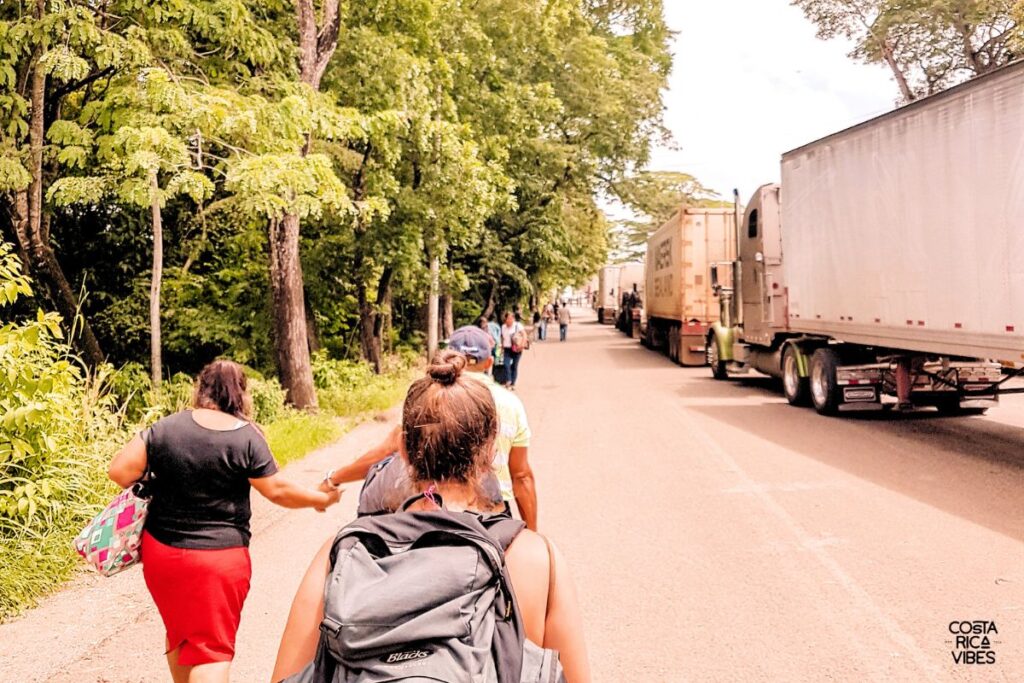
After getting your exit stamp you’ll walk a stretch of road lined with trucks, vendors selling snacks and drinks, and more money changers. Just keep walking straight. Officers will verify your Costa Rica exit stamp along the way.
Note: If you go by bus that is transferring you to your final destination, you might not have to walk this. The bus might take you instead.
Step 3: Enter Nicaragua
You’ll arrive at the Nicaraguan immigration building.
- Pay the $12 USD entry fee directly to the immigration officer
- Present your passport and get your entry stamp. Most Western passport holders receive a 90-day tourist stamp without needing a visa in advance
- Put your bags through the X-ray scanner
- Pay a $1 USD municipality fee near the exit
That’s it! You’re in Nicaragua. Total budget for crossing in: around $13 USD on the Nicaraguan side plus $8-10 USD on the Costa Rican side.
Crossing from Nicaragua back into Costa Rica: Step by Step
And if you need to do this whole thing in reverse….
Exiting Nicaragua:
The exit office is the same building as the entry, just on the other side. You’ll pay a $3 USD exit fee plus another $1 USD municipality tax at a small booth on the right as you enter. Hand over your passport, get your exit stamp, and head back toward Costa Rica.
Entering Costa Rica:
Fill out your entry form and show proof that you’ll be leaving Costa Rica within your allowed stay. A flight reservation or bus ticket works as proof. Wait in line, hand your passport and paperwork to the immigration officer, put your bags through the CT scanner, and you’re done.
How Long Does It Take?
Plan for 1 to 3 hours depending on how busy it is. We’ve done it in under an hour but busy travel days (especially around holidays) can back things up significantly. Earlier in the day is always better.
Important: do not arrive close to closing time. The border operates daily from 6am to 10pm, closing at 8pm on Sundays. They don’t wait.
Just Want to See Nicaragua for the Day? Try This Tour

If you’re based in Guanacaste for your vacation and want to experience Nicaragua without figuring out the border crossing yourself, this full day guided tour is a fantastic option. Your guide handles all the border logistics so you can just sit back and enjoy.
The day covers:
- the Catarina Viewpoint with sweeping views over Lake Nicaragua and Mombacho Volcano
- the Masaya Artisan Market for souvenirs and local food
- the active Masaya Volcano where you can stand right at the crater rim (it’s very cool)
- the beautiful colonial streets of Granada
- a sunset boat cruise on Lake Nicaragua with a stop at Monkey Island.
Pickup starts around 4-4:30am from Guanacaste hotels. It’s a long day but the reviews are consistently excellent with over 570 reviews and a 4.6 rating.
👉 Nicaragua Full Day Tour from Tamarindo/Guanacaste
Tips Summary
- Bring small USD bills in $1, $5, $10. Border fees are cash only and officials rarely have change
- Download the XE Currency app before you go and always count any exchanged money before walking away
- Budget around $25-27 USD total for all fees crossing both directions
- Proof of onward travel is required to enter Costa Rica. A flight reservation or bus ticket works
- Plan for 1-3 hours at the border. Earlier in the day is always better
- Do not arrive close to closing time
- Keep all valuables with you at all times. Do not put anything important in the overhead compartment and fall asleep
- If waiting for transportation on the Nicaragua side, don’t believe anyone who tells you the bus isn’t running. It’s a common tactic to push tourists into taking taxis
- If driving to the border, Costa Rican rental cars cannot cross into Nicaragua. Parking near the border costs around $3-10 USD per day. The better choice would be to return your car in Liberia first.
- Check the current U.S. State Department travel advisory before your trip
- Get travel insurance. We always recommend Heymondo
Final Thoughts
The Costa Rica Nicaragua border crossing at Peñas Blancas is completely manageable when you know what to expect.
Go in prepared with small bills, the right documents, a booked shuttle, and a realistic sense of the safety situation and you’ll be fine.
Just do your research, keep your wits about you, and enjoy what Nicaragua has to offer.
Have questions about the crossing? Drop them in the comments. We’re happy to help.
Plan Your Costa Rica Trip Like a Pro
🏨 Browse our hand-picked hotels: Search stays we actually recommend, with smart filters, clear locations, and plenty of free-cancellation options.
🏡 Find vacation rentals that make sense for your trip: From jungle villas with pools to laid-back beachfront homes.
🚗 Save 10% on your car rental: Plus free second driver, 0% deductible, and great service (this is who we use ourselves).
🚐 Compare shuttles & private transfers: Easy airport pickups and point-to-point rides anywhere in Costa Rica. Use code: SARAHMC5 at checkout.
✈️ Compare flights: We use Skyscanner to compare routes, prices, and flexible dates, especially helpful when flying into or out of Costa Rica’s different airports.
🛡️ Travel insurance: We always recommend traveling Costa Rica with insurance that covers medical care, trip interruptions, and adventure activities. It’s one of those things you hope you don’t need, but are very glad to have if plans change.
You might also be interested in:
- Costa Rica and Panama Border Crossing: How to Get Across Without the Stress
- Costa Rica Entry Requirements (2026): Passport, Visa Rules & Travel Tips
- Full Guide to Liberia Airport in Costa Rica
- Backpacking Costa Rica: Everything You Need to Know Before You Go
- Best Things to Do in Guanacaste, Costa Rica: Epic Activities for Sun, Surf, and Adventure
Travel easier
Plan Smarter, Travel Easier
Before you go, here are the tools we use for every Costa Rica trip.
Need help planning? Try our free day-by-day trip planner, grab our 7-day itinerary for first-timers, or join our email list and we will walk you through it step by step.

Meet the writer
Sarah McArthur
Sarah is the co-founder and main writer of Costa Rica Vibes. Originally from the US, she has lived in San José, Costa Rica since 2016 with her husband Thomas, who takes the photos you see on this site.
Together they have been writing about Costa Rica since 2017, drawing on years of road trips, hotel stays and tours around the country. We personally vet everything before we publish it.
Follow along on Instagram · Pinterest · Substack
or join our email list for trip planning help.
Meet the writer
Sarah McArthur
Sarah is the co-founder and main writer of Costa Rica Vibes. Originally from the US, she has lived in San José, Costa Rica since 2016 with her husband Thomas, who takes the photos you see on this site.
Together they have been writing about Costa Rica since 2017, drawing on years of road trips, hotel stays and tours around the country. We personally vet everything before we publish it.
Follow along on Instagram · Pinterest · Substack
or join our email list for trip planning help.