Are you wondering about the Costa Rica entry requirements before your trip? Whether you’re arriving by air, land, or sea, there are a few important rules travelers need to know before entering the country. The good news is that Costa Rica’s entry requirements are fairly straightforward and tourism-friendly.
We’ve lived in Costa Rica for years and have helped countless friends and family visit from the United States and Europe. Over time we’ve become very familiar with the entry process (and yes… I’ve even been denied boarding once, you can read that story later in this post).
Below we’ll walk you through everything you need to know about entering Costa Rica in 2026, including passport rules, visa requirements, how long you can stay, vaccine requirements, and what to expect when going through immigration.
Let’s get to it!
Costa Rica Entry Requirements At a Glance (2026)
If you just want the quick version, here are the main entry requirements for most travelers visiting Costa Rica.
- Passport: Must be valid for the duration of your stay
- Visa: Not required for most visitors from the US, Canada, UK, EU, and many other countries
- Length of stay: Up to 180 days as a tourist (determined by the immigration officer on arrival)
- Onward travel: You must show proof you will leave the country within your allowed stay
- Vaccines: Yellow Fever vaccine required if arriving from certain countries in South America or Africa
- Departure tax: $29 USD when leaving Costa Rica (usually included in airline tickets)
For most travelers visiting Costa Rica on vacation with a valid passport and round-trip flight, the entry process is very straightforward.
Passport Requirements for Costa Rica
To enter Costa Rica you must have a valid passport from your home country.
Your passport must:
• Be valid for the entire duration of your stay in Costa Rica
• Not be damaged (no ripped pages, holes, etc.)
• Have at least one blank page for entry and exit stamps
Even though Costa Rica itself only requires the passport to be valid for your stay plus one day, I suggest that you make sure your passport is good for at least 3 months from the time you will leave Costa Rica. I have been denied international travel in the past due to passport validity length, so it is always better to be on the safe side.
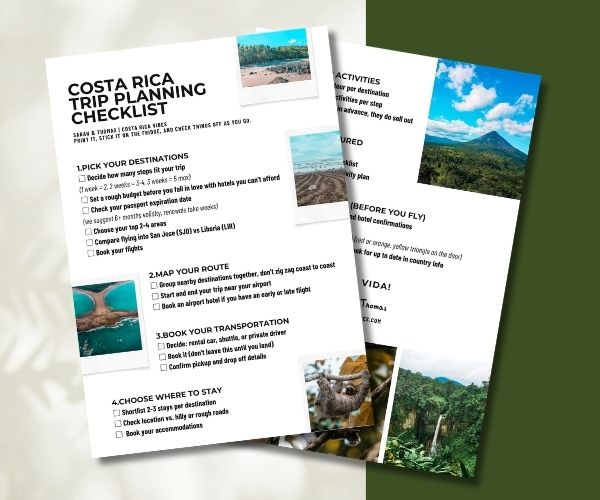
Is Costa Rica planning feeling overwhelming? Let us break it down for you.
Sign up for free, step by step guidance (plus your printable planning checklist right now) and we’ll tell you exactly what to do next, and when.
If you do not have a passport we suggest ordering one from your home country several months in advance of your trip. It can sometimes take a while for everything to be processed.
If you are a US citizen you can order a new passport here. It is possible to expedite it if you are short on time.
Also, make sure you have at least one available page in your passport for entry and exit stamps.
You may be denied entry if your passport is severely damaged. This includes having holes, being ripped, etc.
Travel tip: We always suggest bringing a few printed copies of your passport when traveling. A printed copy of your passport can help expedite the temporary passport process if it gets lost or stolen while you are in Costa Rica.
💡 Sarah’s Tip
Make sure your passport is good for at least 3 months from the day you leave Costa Rica, with at least one empty page for stamps. We always bring a few printed copies of our passports too.
Visa Requirements to Enter Costa Rica
Costa Rica divides countries into four different groups based on visa requirements. Each group has slightly different rules for entering the country.
Group One (No Visa Needed)
Citizens from the countries listed below do not need a visa to visit Costa Rica for tourism.
If you are from one of these countries, you will simply receive an entry stamp in your passport when you arrive. This usually allows you to stay for up to 180 days, although the exact number of days is always determined by the immigration officer.
This group includes most visitors to Costa Rica (USA, Canada, European Union, UK, Australia).
Here is the full list of countries:
Andorra, Argentina, Australia, Austria, Bahamas, Barbados, Belgium, Brazil, Bulgaria, Canada, Chile, Croatia, Cyprus, Czech Republic, Denmark, Estonia, Finland, France, Germany, Greece, Holy See (Vatican), Hungary, Iceland, Ireland, Israel, Italy, Japan, Latvia, Liechtenstein, Lithuania, Luxembourg, Malta, Mexico, Monaco, Montenegro, Netherlands, New Zealand, Norway, Panama, Paraguay, Peru, Poland, Portugal, Qatar, Romania, San Marino, Serbia, Singapore, Slovakia, Slovenia, South Africa, South Korea, Spain, Sweden, Switzerland, Trinidad and Tobago, Ukraine, United Arab Emirates, United Kingdom, United States of America, and Uruguay.
Group Two (No Visa Needed, Shorter Stays)
Citizens from the following countries do not need a visa to enter Costa Rica, but they are usually granted a shorter stay than Group One travelers.
In most cases, visitors from these countries may receive up to 30 days in Costa Rica, depending on the decision of the immigration officer when they arrive.
Countries in this group include:
Antigua and Barbuda, Belize, Bolivia, Brunei, Dominica, El Salvador, Federated States of Micronesia, Fiji, Grenada, Guatemala, Guyana, Honduras, Kiribati, Malaysia, Maldives, Marshall Islands, Mauritius, Nauru, Northern Mariana Islands, Palau, Philippines, Russian Federation, Saint Kitts and Nevis, Saint Lucia, Saint Vincent and the Grenadines, Samoa, São Tomé and Príncipe, Seychelles, Solomon Islands, Suriname, Taiwan, Tonga, Turkey, Tuvalu, and Vanuatu.
Group Three (Visa Required Before Travel)
Citizens of the following countries must apply for a tourist visa before traveling to Costa Rica.
This visa needs to be requested through a Costa Rican embassy or consulate in the traveler’s home country.
Once the visa is approved, travelers have 60 days to enter Costa Rica. The initial stay is usually up to 30 days, but it may be extended for a maximum stay of 90 days.
Countries in this group include:
Algeria, Angola, Armenia, Bahrain, Benin, Belarus, Bhutan, Bosnia and Herzegovina, Botswana, Burkina Faso, Burundi, Cambodia, Cape Verde, Central African Republic, Chad, China, Colombia, Comoros, Democratic Republic of the Congo, Djibouti, Dominican Republic, East Timor, Ecuador, Egypt, Equatorial Guinea, Eswatini, Gabon, Gambia, Georgia, Ghana, Guinea, Guinea-Bissau, India, Indonesia, Ivory Coast, Jordan, Kenya, Kosovo, Kuwait, Laos, Lebanon, Lesotho, Liberia, Libya, Madagascar, Malawi, Mali, Moldova, Mongolia, Morocco, Mauritania, Namibia, Nepal, Niger, Nigeria, North Macedonia, Oman, Pakistan, Papua New Guinea, Republic of the Congo, Rwanda, Saudi Arabia, Senegal, Sierra Leone, Sudan, South Sudan, Tanzania, Thailand, Togo, Tunisia, Uganda, Venezuela, Vietnam, Western Sahara, Yemen, Zambia, and Zimbabwe.
Group Four (Restricted Visa Required)
Citizens from the following countries must obtain a restricted visa before traveling to Costa Rica.
This type of visa requires approval from both the Costa Rican embassy or consulate and the Costa Rican Directorate of Immigration.
Travelers are usually granted an initial stay of up to 30 days, which can sometimes be extended to a maximum of 90 days.
Countries in this group include:
Azerbaijan, Bangladesh, Cuba, Eritrea, Ethiopia, Haiti, Iran, Iraq, Jamaica, Kazakhstan, Kyrgyzstan, Myanmar, North Korea, Palestine, Somalia, Sri Lanka, Syrian Arab Republic, Tajikistan, Turkmenistan, and Uzbekistan.
Keep in Mind
The exact number of days you are granted is determined by the immigration officer when you arrive.
To enter under the visa waiver under one of the valid countries you must have:
- A valid passport
- A return or onward ticket showing you will leave Costa Rica within 180 days
- Proof of sufficient funds for your stay (rarely requested but technically required)
If you plan to stay longer than 180 days, you will need to apply for residency or a visa through Costa Rica’s immigration system.
If you are unsure about your visa status, check with the Costa Rican embassy or consulate in your country before traveling.
Costa Rica Vaccine Requirements

If you are traveling directly from the United States, Canada, the UK, or Europe, there are no required vaccines to enter Costa Rica.
However, the Yellow Fever vaccine is required if you are arriving from certain countries in South America or Africa where the disease is present.
This includes countries such as:
- Brazil
- Colombia
- Ecuador
- Peru
- Bolivia
- Venezuela
- Angola
- Ghana
- Nigeria
- Democratic Republic of Congo
(and several others)
The vaccine must be administered at least 10 days before travel, and you must carry proof of vaccination in the for of a Yellow Fever Vaccination Certificate.
Keep in mind that even if you just have a stopover in one of these countries on your way to Costa Rica and never leave the airport, you will still need the Yellow Fever vaccine.
How Long Can I Stay in Costa Rica?
As of recent immigration updates, tourists in group one can now stay up to 180 days in Costa Rica.
The exact number of days allowed will be written in your passport by the immigration officer when you arrive.
Before entering the country you must show proof that you will leave Costa Rica within the permitted time.
Examples of acceptable proof include:
- A round-trip flight ticket
- A flight departing from another country
- A pre-purchased bus ticket to Nicaragua or Panama (with your passport number on it)
- Cruise itinerary if you are visiting by cruise ship
For most travelers, a round-trip flight is all you will need. You usually don’t need a printed copy. Showing your ticket on your phone is typically fine.
If you are traveling with a one-way ticket, airlines may require proof of onward travel before allowing you to board your flight to Costa Rica. In this situation, many backpackers purchase a refundable onward flight or a bus ticket through TicaBus, which includes your passport number on the ticket.
In our experience, the onward ticket requirement is usually checked by the airline before you depart, rather than by immigration when you arrive.
If you are simply visiting Costa Rica for vacation with a round-trip flight booked, you will likely have no issues entering the country.
Border Control at Airports in Costa Rica

Border control at both the international airports in the country (Juan Santamaria International Airport in San Jose and Liberia International Airport in Liberia) tends to be pretty stress-free.
After exiting the plane we suggest walking relatively quickly to the Border Control area. It can get backed up if there are not a lot of employees working. We once stood in line for about 2 hours. Ugh!
When you get up to the Border Control desk the immigration officer will first ask to see your current valid passport.
The Immigration Official will then usually ask 3 questions:
1. What is your profession?
Just answer them with your general title like “teacher, marketing, programmer etc.” They have a list of careers that they need to check something off of, so don’t get too detailed.
2. Where you are staying on your first night?
You just need to give them the name of the hotel or vacation rental you are staying at on your first night and its location.
If you are staying with friends, just give them the name of the closest hotel. There are no addresses in Costa Rica so it will be very difficult to explain exactly where your friend lives.
3. What is the duration of your stay in Costa Rica?
They just need to know the date of your departure from Costa Rica. They may also ask to see your flight info to prove you have a return ticket.
As I mentioned above, it is fine to show this on your phone but it is a good idea to have it ready to show so you don’t have to scroll through all your emails while standing there.
Occasionally the Costa Rican immigration officer may ask for additional information, but typically those three questions are the only ones you will be asked.
After that, your passport will be stamped with an entry stamp and the officer will write the number of days you are allowed to stay. That’s it! Next, it’s time to collect your checked baggage.
Costa Rica Customs Rules (Food and Items You Cannot Bring)
After collecting your luggage at the airport, you will pass through a customs inspection before exiting the terminal. In most cases this is quick and simply involves placing your bags through an x-ray scanner.
Costa Rica has regulations about what travelers can bring into the country. These rules are mainly designed to protect local agriculture and wildlife.
Items that are generally not allowed or restricted include:
- Fresh fruits and vegetables
- Fresh meat or dairy products
- Seeds and plants
- Soil or plant materials
- Certain animal products
Packaged foods for personal consumption are usually fine, but customs officials have the final decision on whether an item is allowed into the country.
If you are carrying large quantities of food, plants, agricultural products, or over $10,000 USD in cash, you should declare them when entering the country.
For most tourists arriving with normal luggage, the customs process is very quick and rarely involves additional questioning.
However, if they give you fruit on the plane, it’s best to throw it out ahead of time. Truthfully, they rarely actually check or care.
Once, Thomas had an apple in his bag that he forgot about. The officer said to him, “I see you have an apple in your bag.” Thomas apologized, pulled it out, and threw it in the trash. The officer responed, “oh no! You didn’t need to throw it out! I ws just pointing out that I recognized it.” Haha.
We have a full guide to landing in San Jose and a full guide to Liberia International Airport to help you with stuff like ground transportation, exchanging money, etc.
Border Control at the Land Borders with Panama or Nicaragaua
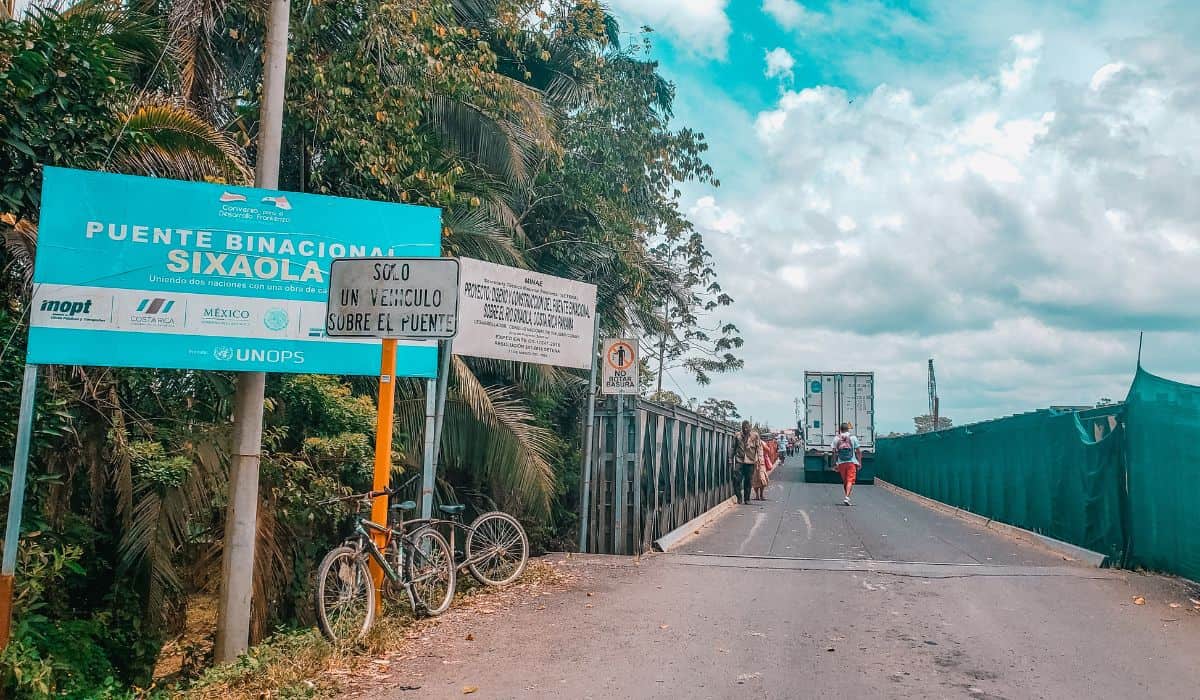
The Nicaragua border and Panama border can be more chaotic than entering the country from one of the airports.
In our experience, the agents can be more controlling and sometimes want to see paper proof of your departure. It is best to have copies of your departure info printed out.
We created a guide to crossing the Nicaragua border and a guide to crossing the Panama border to help you out with this process.
Costa Rica Exit Requirements

When you leave Costa Rica you will first need to pay a departure tax. If you are leaving from the airport, there is a 90% chance this tax is already included in your flight.
If you are crossing land borders you will need to pay this at the official stand.
At the airport, you will then go to security. You will need to show your passport to the local authorities officer.
Next, you will do the usual thing of putting your hand luggage through a conveyer belt and walking through a metal detector. You will then get your luggage back and be in the terminal.
That’s it! No special requirements.
Our Experiences Entering Costa Rica
We have only had one major issue entering the country. Well, actually, I had the major issue. Thomas has never had any problems.
A few years ago we went to the Galapagos (which is a series of islands in Ecuador) for our honeymoon. It was amazing and I made many lifelong friends. ↓

Unfortunately, when it came time to actually leave Ecuador and head back to Costa Rica I was not allowed to fly.
See, before visiting I had researched the Yellow Fever shot and learned that you do not need the vaccine to enter the Galapagos. It is not required by law and there isn’t any Yellow Fever there.
This was a relief because once you get the shot it takes 10 days for it to become active in your system and there was a shortage of Yellow Fever vaccines in Costa Rica at that time.
However, as I stated above, if you travel to Ecuador you need to show proof of the vaccine before you travel to Costa Rica. I had been so focused on looking at the requirements to enter the Galapagos that I hadn’t even looked into the requirements to go back into Costa Rica. I did not know this and so I was not allowed by the airline to fly from Ecuador to Costa Rica.
Thomas, however, was allowed to fly because he had had the vaccine a year earlier.
Our flight was from the Galapagos to Quito, Ecuador. We had a stopover in Quito and then were meant to fly home to San Jose. I was allowed to fly from the Galapagos to Quito, but then was denied boarding in Quito.
After freaking out in the Quito Airport I finally just broke down.
Thomas offered to skip his flight and stay with me, but he needed to get home to go to work the next day and I didn’t want both of us to have to pay for new flights.
He left and I was left alone with no luggage (we had already checked it through to Costa Rica in Thomas’ name before all this drama occurred) and a few credit cards.
After pulling myself together I figured my best option would be to fly to the US and then down to Costa Rica. If I opted to stay in Quito I would have to stay for 10 days after getting the shot. That seemed like too much of a hassle, especially since I didn’t have a single change of clothes.
$400 later I had an overnight flight up to Miami and then down to Costa Rica. Which, as a true Bostonian I was happy to land in the morning in Miami and see a Dunkin Donuts as soon as I exited into the airport. I at least got my Dunkin fix out of my stupidity.
It ended up being quite the adventure, but about 20 hours after Thomas left I finally made it home to Costa Rica.
Anyway, the lesson is, don’t be like me. If you are traveling anywhere in South America, before visiting Costa Rica, get that Yellow Fever vaccine. It will save you a lot of trouble and money.
Other Things to Know About Costa Rica Entry Requirements
- A travel insurance policy is not required in order to enter the country under Costa Rican law, however we still suggest purchasing it. Travel insurance is more than just medical insurance. It will help protect you from things such as lost luggage, a lost passport, changes in travel plans etc. We like Heymondo for Costa Rica travel insurance.
- There are no longer and COVID-related entry requirements such as a negative COVID test, proof of vaccination, or Costa Rica health pass. Those have all been eliminated as requirements.
- If you are a United States citizen, don’t forget to register with STEP. This allows the US government to get in contact with you if there is some sort of emergency while you are traveling in Costa Rica.
- If your passport is lost or stolen while in Costa Rica you will need to make your way to your embassy to try and secure a temporary passport. Most embassies are located in the capital city of San Jose. If you are an American citizen, the U.S. Embassy is located in the Rohrmoser neighborhood of San Jose.
- Don’t forget to check the entry requirements of any country you have a stopover in for an international flight. For example, if you are flying from Europe and have a stopover in the United States you will still need to do ESTA.
Conclusion
In conclusion, the Costa Rican entry requirements aren’t anything crazy. The tourism industry is huge here, so the government tries to do as much as possible to make it easy to visit.
Just note that the information for entry is always changing and we are not legal experts. Check with your local consulate or embassy for updated information before traveling.
If you have any questions about entry requirements for Costa Rica please leave them in the comment section below. We are always happy to help you out!
Plan Your Costa Rica Trip Like a Pro
🏨 Browse our hand-picked hotels: Search stays we actually recommend, with smart filters, clear locations, and plenty of free-cancellation options.
🏡 Find vacation rentals that make sense for your trip: From jungle villas with pools to laid-back beachfront homes.
🚗 Save 10% on your car rental: Plus free second driver, 0% deductible, and great service (this is who we use ourselves).
🚐 Compare shuttles & private transfers: Easy airport pickups and point-to-point rides anywhere in Costa Rica. Use code: SARAHMC5 at checkout.
✈️ Compare flights: We use Skyscanner to compare routes, prices, and flexible dates, especially helpful when flying into or out of Costa Rica’s different airports.
🛡️ Travel insurance: We always recommend traveling Costa Rica with insurance that covers medical care, trip interruptions, and adventure activities. It’s one of those things you hope you don’t need, but are very glad to have if plans change.
✈️ Get help with flight delays or cancellations from AirHelp: If your flight to or from Costa Rica is delayed, canceled, or overbooked, AirHelp helps you check if you’re entitled to compensation, without dealing with airline back-and-forth yourself.
You might also be interested in:
- Costa Rica Airports: Which Is Better, San Jose or Liberia?
- San Jose Costa Rica Airport (SJO) Arrival and Departure Guide
- Full Guide to Liberia Airport in Costa Rica
- Costa Rica Nicaragua Border Crossing: A Complete Guide to Peñas Blancas
- Costa Rica and Panama Border Crossing: How to Get Across Without the Stress
Travel easier
Plan Smarter, Travel Easier
Before you go, here are the tools we use for every Costa Rica trip.
Need help planning? Try our free day-by-day trip planner, grab our 7-day itinerary for first-timers, or join our email list and we will walk you through it step by step.

Meet the writer
Sarah McArthur
Sarah is the co-founder and main writer of Costa Rica Vibes. Originally from the US, she has lived in San José, Costa Rica since 2016 with her husband Thomas, who takes the photos you see on this site.
Together they have been writing about Costa Rica since 2017, drawing on years of road trips, hotel stays and tours around the country. We personally vet everything before we publish it.
Follow along on Instagram · Pinterest · Substack
or join our email list for trip planning help.
Meet the writer
Sarah McArthur
Sarah is the co-founder and main writer of Costa Rica Vibes. Originally from the US, she has lived in San José, Costa Rica since 2016 with her husband Thomas, who takes the photos you see on this site.
Together they have been writing about Costa Rica since 2017, drawing on years of road trips, hotel stays and tours around the country. We personally vet everything before we publish it.
Follow along on Instagram · Pinterest · Substack
or join our email list for trip planning help.