We live in the San José area, which basically means we’re surrounded by coffee. Some of our closest friends own a coffee farm, and over the years we’ve done just about every Costa Rica coffee tour. When friends or family visit, a coffee experience is usually one of the first things we recommend, because it’s one of the easiest ways to understand Costa Rica.
On a coffee tour you’ll see how coffee plants grow in volcanic soil, learn how the harvest works, taste different roast levels, and get a feel for the local families and farmers behind Costa Rica coffee production. I think it’s educational without being boring, and fun without feeling overly touristy (if you choose the right one).
In this guide, we’re covering:
- The best Costa Rica coffee tours by region
- Which tour is best for who
- What to expect during the experience
- The best time to visit (especially if you want to see harvest season)
- And practical tips for booking in 2026
Let’s start with the quick overview.
Costa Rica Coffee Tours at a Glance (2026)
- Central Valley / San José Area (Best overall access)
- Best overall educational experience: Doka Estate
- Best scenic & polished experience: Hacienda Alsacia (owned by Starbucks)
- Best classic Costa Rica brand experience: Café Britt
- Best Turrialba Region: Aquiares
- Best La Fortuna option: North Fields | Don Juan
- Monteverde: Café de Monteverde
- Guanacaste / Liberia Area: Tio Leo Coffee Tour
- Best Time to Visit: October to March (harvest season)
- Family Friendly? Yes, most tours are great for kids
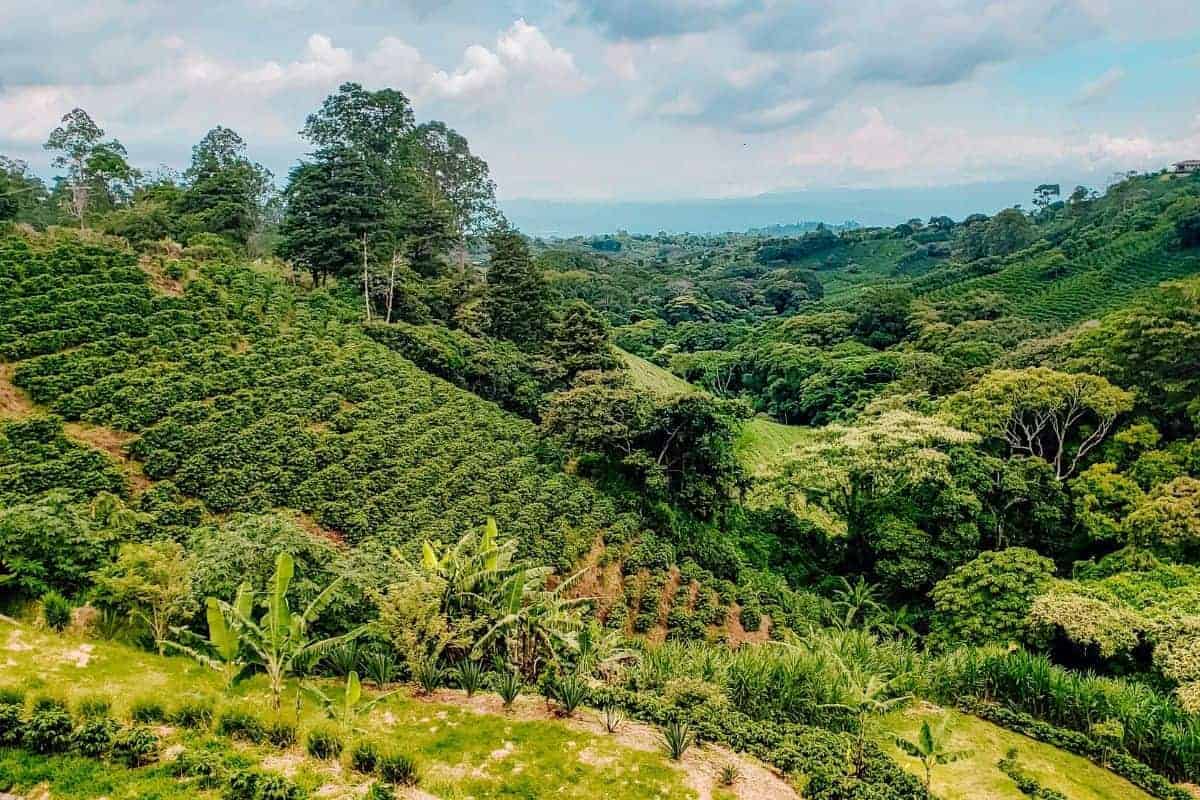
We also made a clickable map of all the coffee farms. You can also open it in Google Maps here.
Central Valley Coffee Tours
Doka Estate
Location: Alajuela, about 40 minutes from San José International Airport
Doka is one of the most complete coffee experiences in the country. You’ll walk through active plantations, see the historic wet mill, drying patios, and learn the full production process from harvest to roasting. Because it’s located on the slopes of Poás, the volcanic soil and elevation create excellent coffee quality.
This is the tour we usually recommend to first-time visitors who want a thorough overview of how Costa Rica coffee works from bean to export. Plus, we think they are a great local company that we are happy to support.
Hacienda Alsacia
Location: Alajuela, near Poás Volcano
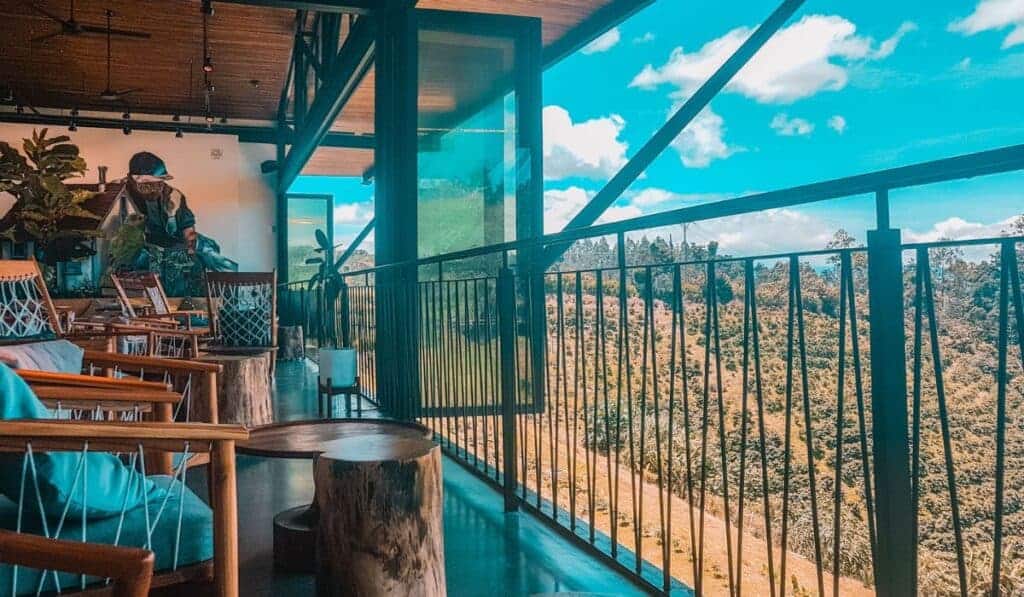
Hacienda Alsacia is the only Starbucks coffee farm open to the public in the world. It’s beautifully maintained, very structured, and offers a polished look at research, sustainability, and global coffee production.
We’ll be honest, it’s more corporate than small farm (and we love to support that little guy when possible), but the setting is stunning. They also have a great open air cafe here. If you don’t want to come for a tour, you could still come for the cafe experience. They serve some interesting drinks that you won’t find at a normal Starbucks.
Is Costa Rica planning feeling overwhelming? Let us break it down for you.
Sign up for free, step by step guidance (plus your printable planning checklist right now) and we’ll tell you exactly what to do next, and when.
Café Britt
Location: Heredia, near San José
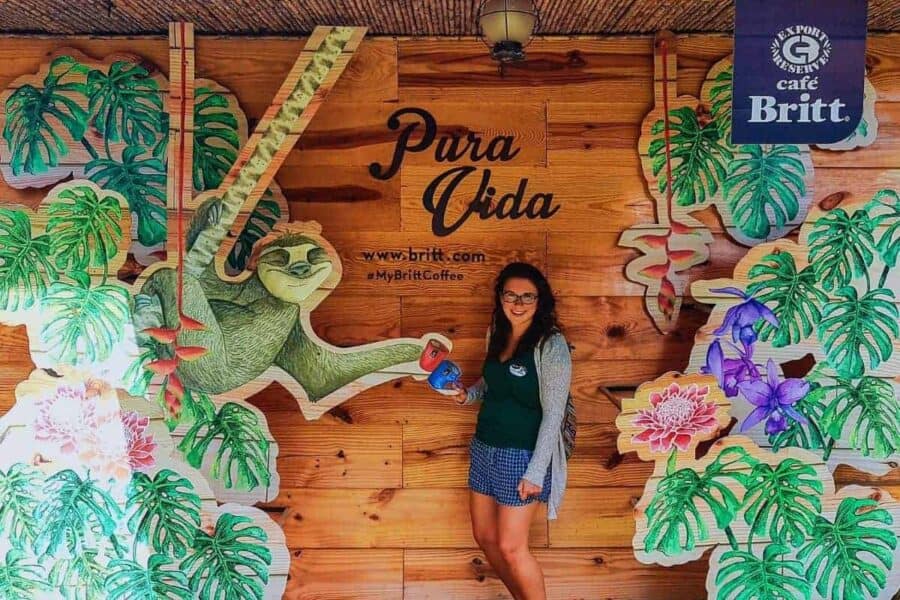
Café Britt is one of the most recognizable Costa Rica coffee brands. Their Classic Coffee Tour is fun, interactive, and very tasting-focused. You’ll learn how flavor changes with roast levels and altitude, and you’ll try multiple samples.
This one feels lighter and more entertaining than deeply agricultural, which some people prefer. It’s great if you’re traveling with kids.
Oh, and last time I was there they let us drink as much coffee as we wanted. I definitely overdid it!
⤷ Check availability of tours with transportation from San Jose included
Aquiares Coffee Tour
Location: Aquiares, near Turrialba
If you’re looking for something that feels less commercial and more community-driven, Aquiares is one of the most unique coffee experiences in Costa Rica.
Unlike many plantation-style tours, this experience begins in the village itself. You’ll start at the local church, walk through the small community, and learn how coffee shaped the town’s development. From there, you’ll move into the agricultural side. The tour explores coffee agronomy, you’ll get the chance to visit the beneficio (processing mill), and you’ll learn about roasting and cupping.
This is Costa Rica’s largest coffee farm by area, but it doesn’t feel industrial. It feels rooted in history. Aquiares has long been considered one of the country’s best-kept coffee secrets, and the focus here is as much on people and culture as it is on the bean.
Keep in mind that this tour is south of San Jose, close to Turrialba Volcano.
Want to actually stay at a coffee farm in the Central Valley? You can do that at Finca Rosa Blanca!

Finca Rosa Blanca is an organic coffee farm and boutique hotel overlooking the Central Valley. As a guest you can tour the farm, learn about biodiversity and coffee plants, and enjoy fresh-roasted beans right on property. It’s an amazing place that we highly recommend.
La Fortuna / Arenal Area
North Fields Coffee Tour
Duration: Approximately 2.5 hours
Hotel Pickup: Available within ~15 minutes of La Fortuna
If you’re staying in La Fortuna, this is hands down one of the most popular coffee experiences in the area.
This is more than just a coffee tour. It also includes chocolate and sugarcane. I will admit, I think the sugarcane aspect is the most interesting. I had somewhat of an idea of how coffee and chocolate were made, but I had never really considered how sugar is processed.
The tour is highly interactive. You will help grind coffee, prepare chocolate, taste fresh sugarcane juice, and sample multiple varieties throughout the experience. The guides are super knowledgeable, funny, and energetic.
What’s included:
- Guided walk through coffee and cacao plantation
- Explanation of the full production process (from seed to cup)
- Chocolate preparation and tasting
- Sugarcane demonstration and sampling
- Unlimited coffee tastings
- Hotel pickup (for nearby hotels)
We like this tour because it is perfect for people of all ages. I mean, who doesn’t like sampling chocolate and coffee?
Don Juan Tours
Duration: Approximately 2 hours
Accessibility: 100% covered and paved trails
If you’re looking for a coffee and chocolate tour in La Fortuna that is polished, accessible, and very hands-on, Don Juan is a good option.
Their motto is “We teach, you create,” and that’s exactly how the experience feels. Instead of just watching demonstrations, you actively participate. You’ll get the chance to grind cacao beans, creating your own chocolate blend, and learning how coffee moves from seed to cup.
The experience is split into two parts:
- First, you’ll follow the journey of Costa Rica coffee, from germination to roasting. Your guide explains harvesting, processing, and flavor development before finishing with a tasting.
- Then comes the chocolate portion. You’ll learn how cacao is transformed from bean to bar and even help grind cacao to make your own chocolate creation. At the end, you’ll sample dark, milk, and white chocolate.
One major advantage of Don Juan is infrastructure. Unlike many farms, all trails are covered and paved. The facility is stroller-friendly and accessible for travelers using walkers or wheelchairs, which is not common for agricultural tours in Costa Rica.
Note: Transportation is not included on this tour unlike with North Fields.
Monteverde – Café de Monteverde
If you’re visiting Monteverde and want a tour that goes beyond tasting and into sustainability, conservation, and community, this is the one to consider.
Café Monteverde is a collective of 21 local families working together under Unión Varsan de Monteverde. Their roots in coffee farming go back to the 1930s, when families from Costa Rica’s Central Valley brought coffee cultivation to the Monteverde region. Today, the farm operates as both a working plantation and a living classroom.
The 2-hour “seed to cup” experience walks you through every stage of sustainable coffee production. You’ll explore germination beds, walk through active coffee plants, learn about harvest and processing (with seasonal coffee picking from October through March), visit the on-site roastery, and finish with a guided tasting of five different coffees.
This tour feels slower and more intentional than some of the higher-energy combo tours in Monteverde. It’s ideal if you care about environmental impact, cooperative farming, and understanding how coffee production supports both biodiversity and local livelihoods.
Guanacaste / Liberia Area: Tio Leo Coffee Tour
If you’re staying in Guanacaste and want something that feels very local, this is a great option near the Liberia Airport. Tío Leo is a small, family-run farm experience where you’re welcomed like part of the family.
This isn’t just a coffee tour. Over about 3.5 hours, you’ll learn about coffee plants, chocolate, sugarcane, and traditional Costa Rican cooking. Guests roast and taste coffee, sample cacao, drink fresh sugarcane juice, and even make their own empanadas. There’s a lot of interaction, a lot of laughter, and a lot of food.
Group sizes are small (max 6 people), which makes the experience more personal. It’s a great experience overall!
💡 Sarah’s Tip
The Aquiares Coffee Tour is south of San Jose near Turrialba Volcano. Pair it with other stops in that area to make the drive worth it.
Want to Know More About Coffee in Costa Rica?
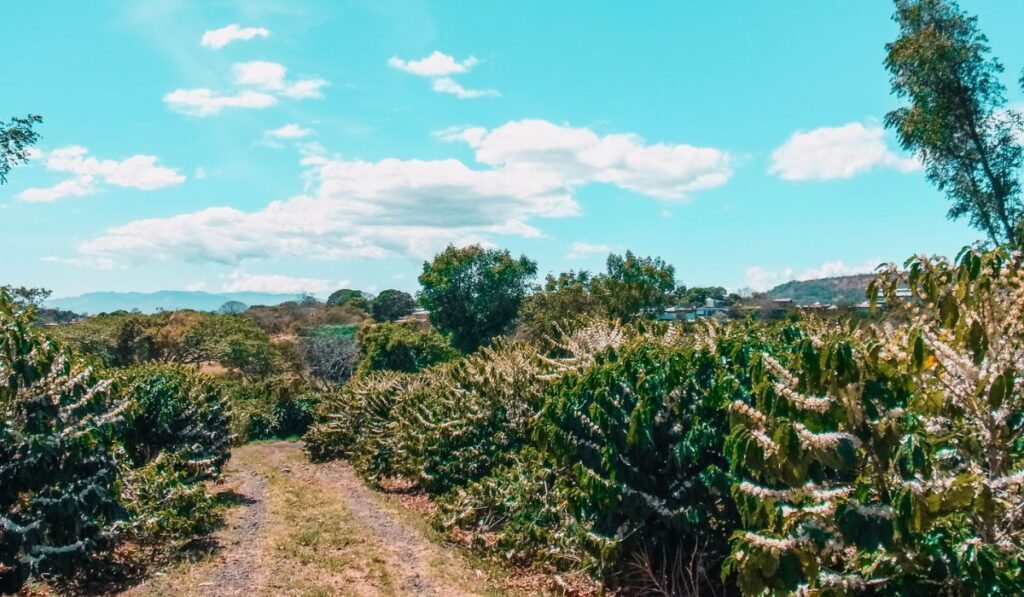
If you’re curious why Costa Rica coffee tastes the way it does, or why it has such a strong reputation worldwide, here’s a quick overview.
A Short History of Coffee in Costa Rica
Coffee production in Costa Rica dates back to the late 1700’s. Arabica coffee plants were introduced from Ethiopia, and the crop quickly became one of the country’s most valuable exports.
By the mid-1800s, coffee was being shipped directly to Europe. The industry helped shape early San José, funded infrastructure, and created entire coffee towns throughout the Central Valley. Many of the historic buildings in the capital were built with coffee money.
Unlike many neighboring countries, Costa Rica eventually shifted away from mass production and focused instead on high-quality coffee. Today, strict regulations protect coffee quality standards, and the country is known for premium beans rather than bulk export.
Why Costa Rica Coffee Is So Highly Regarded
There are a few reasons Costa Rica coffee consistently ranks among the best:
- Volcanic soil: The country’s many volcanoes enrich the soil with minerals, which directly impact flavor and coffee quality.
- High elevation: Most coffee plants are grown at higher altitudes, which slows the development of the coffee bean and creates more complex tastes.
- Microclimates & biodiversity: Different regions (Turrialba, Tarrazú, Heredia, Monteverde) produce slightly different flavor profiles because of rainfall, temperature, and elevation differences.
- Quality control laws: Costa Rica legally requires that only Arabica coffee beans be grown commercially. This protects the country’s reputation for high-quality coffee.
Understanding the Coffee Production Process
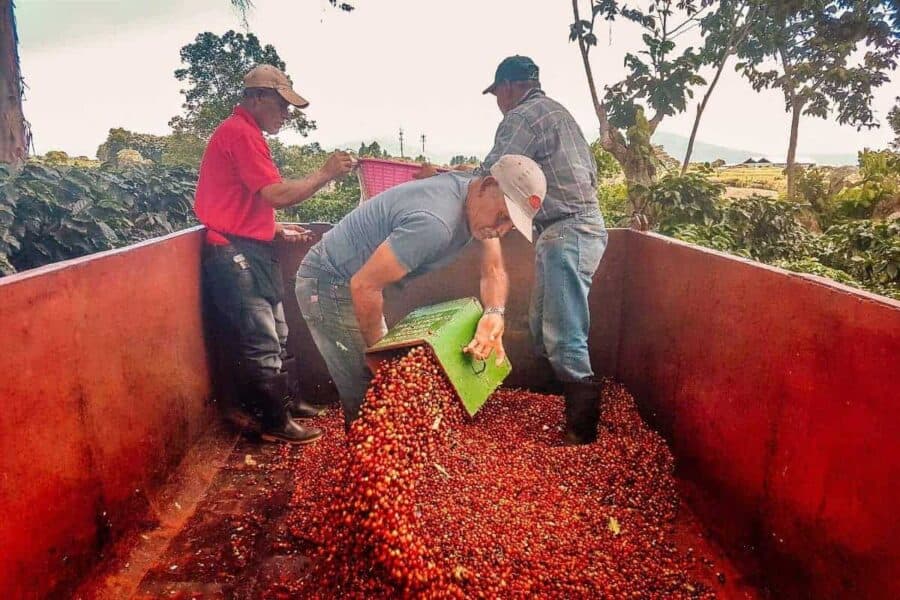
When you take a coffee tour, you’ll hear a lot about the production process. So, this might be a spoiler alert for those of you who want to leave the knowledge-gaining to the tours.
But, here’s a simplified version of what actually happens:
- Planting: Coffee plants begin in shaded nurseries before being transplanted to plantations. It takes about 3 to 4 years before a plant produces its first harvest.
- Flowering & Coffee Cherries: The plants bloom with small white flowers before producing green coffee cherries. When ripe, the cherries turn bright red.
- Harvest: Harvest season typically runs from October through March. Workers hand-pick only the ripe cherries to maintain coffee quality. If you visit during this time, you may see the harvest in action.
- Processing: After picking, the outer pulp is removed from the bean. Costa Rica uses several methods, including washed and honey processing (where some fruit remains on the bean during drying, adding sweetness).
- Drying & Roasting: Beans are dried in the sun, sorted, and either exported or roasted locally. Some farms have their own roaster, allowing you to taste extremely fresh coffee.
- Traditional Brewing: You’ll likely see the traditional Costa Rican “sock” method. This is a cloth filter that locals have used for generations. It’s very typical Costa Rican and actually what we use at home since we have lived here.
When Is the Best Time to Visit a Coffee Farm?
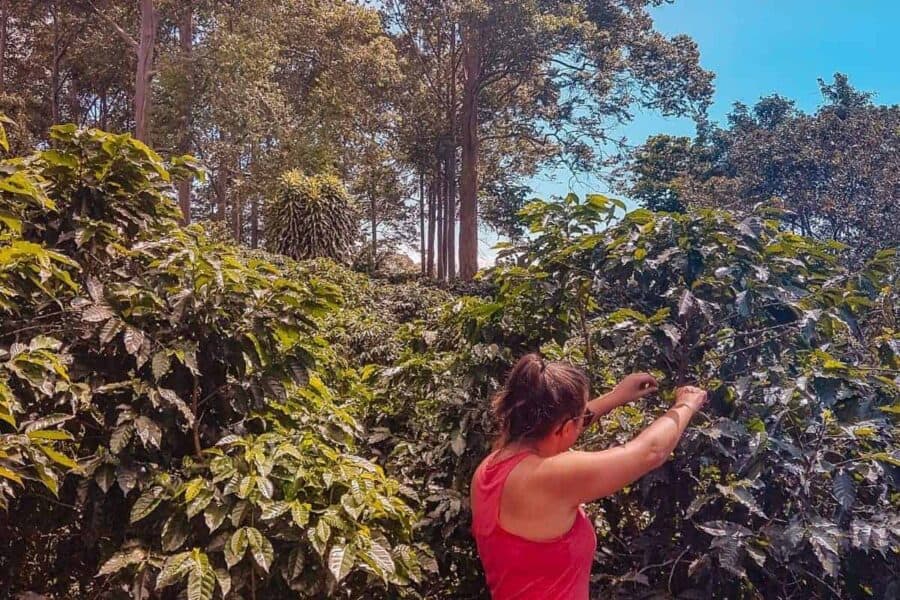
If you want to see active harvest, the best time is October through March.
April can still be a good month to visit, but most harvesting slows down. That said, tours operate year-round and still walk you through every stage of the coffee experience. So, it’s always a good time in our opinion!
Planning your trip? Check out our full Cartago travel guide for where to stay, where to eat and our favorite things to do.
Frequently Asked Questions About Costa Rica Coffee Tours
Where can you do coffee tours in Costa Rica?
The best coffee tours are in the Central Valley near San José, including Doka Estate, Hacienda Alsacia, and Café Britt. You’ll also find great options in La Fortuna, Monteverde, Turrialba, and Guanacaste.
Why is Costa Rica coffee so good?
Costa Rica coffee is known for its high quality due to volcanic soil, high elevations, and strict agricultural regulations. Only Arabica beans are grown commercially, and slower-growing plants at altitude produce more complex flavors.
Where is coffee grown in Costa Rica?
Coffee is primarily grown in the Central Valley, Tarrazú, Turrialba, Heredia, and Monteverde regions. These areas have ideal elevation, rainfall, and mineral-rich volcanic soil.
Can you bring coffee back to the United States from Costa Rica?
Yes, roasted or ground coffee for personal use can be brought back to the US. It should be commercially packaged and sealed. Coffee is one of the most popular souvenirs from Costa Rica.
Most of our favorite coffee tours are located outside of major beach towns, so having a rental car makes things much easier. We always recommend reserving your car in advance, particularly during dry season.
Don’t forget, we have this map for you of all the coffee farms throughout the country
If you’re flying into San José or Liberia, consider spending your first or last night near the airport and adding a coffee tour to that day. It’s a relaxed way to start (or end) your Costa Rica trip.
If you’re already planning your itinerary, a coffee tour is one of the easiest experiences to slot into almost any route. Let us know in the comment section if you have any questions. we are always happy to help you plan!
Plan Your Costa Rica Trip Like a Pro
🚗 Save 10% on your car rental: Plus free second driver, 0% deductible, and great service (this is who we use ourselves).
🚐 Compare shuttles & private transfers: Easy airport pickups and point-to-point rides anywhere in Costa Rica. Use code: SARAHMC5 at checkout.
🐒 Book tours with Viator: We use Viator to compare reputable tour operators, check real reviews, and book experiences with flexible cancellation.
📱 Stay connected with an eSIM: Get easy data as soon as you land. No SIM cards, no airport lines, and way cheaper than roaming.
✈️ Compare flights: We use Skyscanner to compare routes, prices, and flexible dates, especially helpful when flying into or out of Costa Rica’s different airports.
🛡️ Travel insurance: We always recommend traveling Costa Rica with insurance that covers medical care, trip interruptions, and adventure activities. It’s one of those things you hope you don’t need, but are very glad to have if plans change.
You might also be interested in:
Travel easier
Plan Smarter, Travel Easier
Before you go, here are the tools we use for every Costa Rica trip.
Need help planning? Try our free day-by-day trip planner, grab our 7-day itinerary for first-timers, or join our email list and we will walk you through it step by step.

Meet the writer
Sarah McArthur
Sarah is the co-founder and main writer of Costa Rica Vibes. Originally from the US, she has lived in San José, Costa Rica since 2016 with her husband Thomas, who takes the photos you see on this site.
Together they have been writing about Costa Rica since 2017, drawing on years of road trips, hotel stays and tours around the country. We personally vet everything before we publish it.
Follow along on Instagram · Pinterest · Substack
or join our email list for trip planning help.
Meet the writer
Sarah McArthur
Sarah is the co-founder and main writer of Costa Rica Vibes. Originally from the US, she has lived in San José, Costa Rica since 2016 with her husband Thomas, who takes the photos you see on this site.
Together they have been writing about Costa Rica since 2017, drawing on years of road trips, hotel stays and tours around the country. We personally vet everything before we publish it.
Follow along on Instagram · Pinterest · Substack
or join our email list for trip planning help.